

A well-lit yard changes how a property feels after sunset. It looks more polished, more inviting, and much easier to use. The best outdoor landscape lighting ideas do not treat safety and style as separate goals. They build both at the same time.
That matters for homeowners, property managers, and businesses alike. A dark front walk can lead to trips. A dim side yard can feel uneasy. A flat, overly bright lighting setup can wash out the architecture you want people to notice. Thoughtful lighting fixes all three problems by guiding movement, showing off textures, and reducing the dark pockets that make a property feel unfinished.
In Arizona neighborhoods, where outdoor living is part of daily life for much of the year, lighting also extends the usefulness of patios, courtyards, entryways, and garden spaces. A yard that disappears at dusk is leaving value on the table.
Outdoor landscape lighting ideas for safer walkways, steps, and entryways
Safety should start with the routes people use most often. That means the front walk, driveway, porch, gate, side yard access, steps, and any change in elevation. Even a modest lighting plan can make these areas much easier to use by showing edges clearly and removing dark gaps between fixtures.
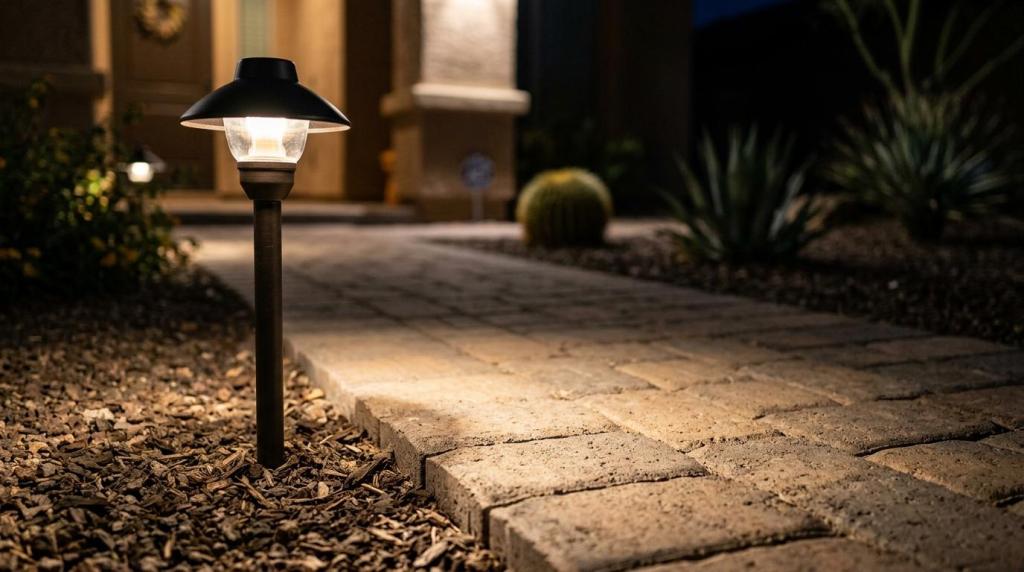
Path lights are one of the most effective tools here. Set low to the ground, they cast a soft spread of light that defines the walking surface without creating glare. Step lights take that a step further by highlighting risers and tread edges, which helps guests see depth more clearly. This is especially useful around raised patios, retaining walls, and sloped walkways.
Good safety lighting is not about flooding every inch of the yard with brightness. It is about placing light where people need visual cues most.
After identifying the main walking routes, focus on the areas that tend to create nighttime risk:
- Front walkway
- Porch and entry threshold
- Steps and grade changes
- Driveway edges
- Side-yard gates
- Pool, patio, and deck transitions
Security benefits come from the same disciplined approach. Research on public lighting has shown meaningful reductions in nighttime crime after lighting upgrades, and the principle carries over to residential design. When entry points, side yards, and rear access areas are visible, an intruder has fewer places to stay hidden. Motion-activated fixtures near gates, garages, and back corners add another layer without keeping a harsh light on all night.
A couple of porch lights rarely cover everything that matters. A better plan creates clear sightlines from the street to the front door, from the driveway to the garage, and from the patio to the yard perimeter.
Outdoor landscape lighting ideas that boost curb appeal after dark
Once the essential safety zones are covered, curb appeal becomes the fun part. This is where lighting brings dimension to the property and gives the landscape a finished look long after the sun goes down. Trees look taller. Stone textures stand out. Garden beds gain depth. The home itself feels more welcoming from the curb.
Uplighting is one of the most reliable ways to create that effect. A fixture placed at ground level and aimed upward can draw attention to a specimen tree, a textured wall, a column, or a large cactus grouping. The goal is not to light everything equally. It is to guide the eye toward the strongest elements in the landscape.
Shadowing and silhouetting can add even more interest. A finely branched tree placed near a wall can cast soft patterns that move with the breeze. A sculptural plant or garden feature lit from behind can produce a crisp outline that feels dramatic without looking flashy. These techniques work especially well when the architecture has clean surfaces that can catch light and shadow.
Layering is what gives a property a high-end nighttime look.
The table below shows how common lighting ideas work in practice.
| Lighting technique | Best use | Visual effect | Safety value |
|---|---|---|---|
| Path lighting | Walkways, drive borders, garden paths | Clean definition and soft glow | Helps prevent trips and missteps |
| Step lighting | Stairs, retaining wall steps, raised patios | Crisp edge visibility | Improves footing and depth perception |
| Uplighting | Trees, columns, facades, tall plants | Height, texture, and drama | Keeps key areas visible |
| Downlighting | Patios, seating areas, lawn zones | Natural moonlight effect | Adds broad ambient coverage |
| Accent lighting | Fountains, sculptures, specimen plants | Focus and contrast | Keeps focal areas readable at night |
| Motion lighting | Side yards, garage areas, gates | Sudden illumination on activity | Deters unwanted movement |
The strongest curb appeal usually comes from combining three layers: functional light for movement, accent light for focal points, and ambient light for atmosphere. A property that uses only one of those layers often feels either too dim or too flat.
Landscape lighting color temperature and brightness tips
Fixture placement gets most of the attention, yet color temperature has a major impact on the final look. Warm white light, usually in the 2700K to 3000K range, is popular for residential landscapes because it feels natural and welcoming. It flatters stone, wood, desert plantings, and most home exteriors.
Neutral white light, closer to 3000K to 4000K, can work well on busy walkways or mixed-use commercial spaces where clarity matters a bit more. Cooler light, often 4000K to 5000K, is best used selectively for security zones, service areas, or motion-triggered fixtures where visibility is the top priority.
Here is a simple guide:
| Color temperature | Best fit | Typical result |
|---|---|---|
| 2700K to 3000K | Front yards, planting beds, patios, facade accents | Warm, inviting, residential feel |
| 3000K to 4000K | Walkways, common areas, commercial entries | Balanced visibility with less harshness |
| 4000K to 5000K | Security zones, side yards, service access | Bright, crisp visibility |
Brightness matters just as much. A path light that is too weak leaves dark gaps. One that is too strong creates glare and harsh contrast. The right level gives enough illumination to read the surface underfoot while keeping the yard comfortable to look at. In many projects, low-voltage LED fixtures spaced with care will do the job better than a smaller number of very bright fixtures.
This is one place where restraint usually wins. More light does not always mean better lighting.
LED and smart outdoor landscape lighting ideas for Arizona properties
LED systems have become the standard for good reason. They use less energy, last longer, and offer better control over beam spread and color temperature than older lamp types. For a property owner, that means lower maintenance, steadier performance, and a cleaner nighttime appearance.
Low-voltage LED lighting is especially useful in residential landscapes because it is efficient and flexible. Fixtures can be placed along paver walks, around planting beds, near water features, and under walls or seating elements without making the system overly complex. For commercial properties, the same approach supports cleaner layouts and more predictable coverage.
Smart controls make the system work harder without adding effort to the owner’s routine. Timers, photocells, and motion sensors let lights turn on at the right time and shut off when they are no longer needed. This is good for energy use, yet it also keeps the property consistently lit when people are arriving home, leaving for work early, or using the patio in the evening.
A practical smart-lighting setup often includes:
- Photocells: Turn lights on automatically at dusk
- Timers: Set shutoff times for decorative zones
- Motion sensors: Add extra security near gates and garages
- Zoned lighting
- Seasonal programming
- App-based control where needed
For Arizona landscapes, durability matters too. Heat, dust, irrigation overspray, and sun exposure all put pressure on outdoor materials. Quality fixtures with solid seals, strong finishes, and well-planned wiring hold up better and keep the lighting scheme looking consistent over time.
Outdoor landscape lighting ideas for patios, walls, and focal features
The front yard usually gets the most attention, but backyard and side-yard lighting often has the biggest effect on how often the space is used. A patio with the right lighting becomes a place people want to stay in, not just pass through. The same is true for courtyards, ramadas, outdoor kitchens, and poolside seating areas.
Downlighting mounted on structures or in tree canopies can create a soft wash over dining and lounge areas. Wall lights can bring texture out of masonry and block walls while giving the yard a calmer background glow. Recessed lights tucked into low walls or benches keep the light source hidden and the effect refined.
If the property has a fountain, specimen tree, sculpture, or architectural column, give it a dedicated accent light. One well-lit focal point can organize the entire nighttime view. That is often more effective than scattering fixtures evenly across every bed and border.
Patio lighting works best when the fixtures match the purpose of the space:
- Dining areas: Soft overhead or downlighting with good color quality
- Conversation areas: Lower ambient light with subtle wall or planter accents
- Water features: Focused beam control to avoid glare and highlight movement
- Outdoor kitchens: Brighter task lighting on prep and cooking surfaces
Custom landscape lighting planning for homes and commercial properties
A strong lighting plan starts with how people use the property. Where do guests enter? Which route do residents take from the driveway to the front door? Where are the level changes? What deserves attention from the street? Those answers shape the layout far better than buying a boxed kit and placing fixtures at random.
That is one reason many property owners choose a professional design and installation team. Pro Natural Landscape LLC, a family-owned company serving El Mirage and nearby Arizona communities, provides outdoor lighting as part of broader landscape and hardscape work. Their service mix includes Low-voltage LED lighting, timer installation, design support, and exterior improvements that let the lighting feel integrated with the rest of the property rather than added on as an afterthought.
Their practical approach fits what most owners actually need:
- Path and step lighting: Safer movement from curb to entry and through outdoor living areas
- Uplights and accent fixtures: Better curb appeal for trees, facades, and focal features
- Timers and controls: Reliable scheduling with less wasted energy
- Free estimates
- Financing options through Hearth
For commercial properties, the same design principles apply with a slightly different priority order. Safety and clarity often come first, especially near entries, parking edges, and pedestrian routes. Curb appeal still matters, though. A well-lit storefront, office frontage, or common area signals care, quality, and attention to detail before anyone steps inside.
The best outdoor landscape lighting ideas are rarely the loudest ones. They are the ones that make a property easier to use, easier to appreciate, and more memorable at night.
2 thoughts on “Landscape Lighting Ideas That Improve Safety and Curb Appeal”