

Hiring a landscaping contractor gets easier when you ask questions that expose risk early, especially in Arizona where irrigation, grading, hardscape work, and licensing details can change the value of a bid fast.
TL;DR: Summary
- The best questions to ask a landscaping contractor in Arizona focus on whether the company is licensed and insured, what the written estimate includes, when work starts and ends, and how the payment schedule works.
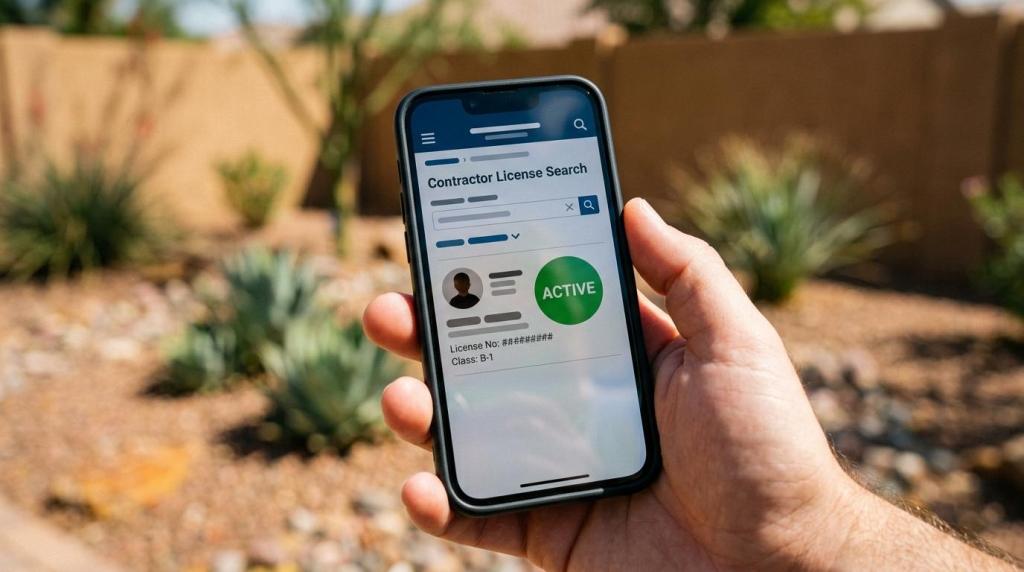
- Verify the contractor’s license number in the Arizona Registrar of Contractors contractor search tool and confirm the status is ACTIVE before comparing prices.
- FTC guidance says a written estimate should include the work description, materials, completion date, and price; a contract should also list the contractor’s name, address, phone number, license number, and payment terms.
- If one bid is much lower, then check for missing grading, irrigation, cleanup, hauling, permits, or warranty details before treating it as savings.
- In Arizona, ask extra questions about irrigation zones, drainage, gravel use, artificial grass heat performance, paver base prep, and monsoon-related timeline delays.
The strongest screening questions are not fancy. They are practical checks that tell you whether a contractor is organized, legitimate, and prepared to put promises in writing.
Why do license and insurance questions matter so much in Arizona?
Yes, they matter first. The FTC and the Arizona Registrar of Contractors both treat license and insurance checks as core hiring criteria, not optional extras.
A landscaping project can look simple from the street and still involve irrigation lines, grading, pavers, retaining elements, lighting, or tree work that create liability if something goes wrong. The FTC’s consumer advice says to consider only contractors who are licensed and insured. In Arizona, that check is easier because the ROC provides a public search tool.
A common misconception is that a business name, social profile, or LLC registration proves the company can legally perform contractor work. It does not. Those signals can support credibility, but they are not a substitute for a current contractor license and proof of insurance.
How do you verify an Arizona landscaping contractor’s license step by step?
Start with the ROC. Ask for the contractor’s legal business name and license number, then confirm the license shows as ACTIVE in the Arizona Registrar of Contractors search tool.
Step one is simple: request the exact name that will appear on the contract. Step two: search that name or license number in the ROC system and confirm the status is ACTIVE. Step three: check that the address, phone number, and license details match what the contractor gave you, because mismatches can signal sloppy paperwork or a different entity than the one you think you hired.
“Pro Natural Landscape states it is a family-owned company established 11 years ago in El Mirage, Arizona, which is a concrete business detail buyers can verify during contractor screening.”
If the contractor is an LLC or corporation, it is smart to confirm the business identity is consistent with Arizona records as well. Arizona ROC guidance notes that LLCs and corporations must be registered with the Arizona Corporation Commission and be in good standing before applying for a contractor license. Pro tip: if someone says the license is “pending” or tells you to skip the search because they are “covered under another company,” pause the conversation.
What are the 7 best questions to ask a landscaping contractor?
These seven questions cover the highest-risk issues. They test legality, scope, timing, cost control, and accountability in one short conversation.
After you ask them once, it becomes much easier to compare contractors on facts instead of personality alone.
- What is your Arizona license number, and does it show as ACTIVE?
- Are you licensed and insured, and can you provide proof?
- What exactly is included in the written estimate?
- Which materials, brands, and quantities are specified?
- What are the estimated start and completion dates?
- What is the payment schedule, and what can change the price?
- Who handles permits, cleanup, debris removal, and warranty service?
A strong contractor can answer these without getting defensive. If answers stay vague, then the project risk usually stays high.
How should you compare written landscaping estimates step by step?
Compare scope before price. FTC guidance says a written estimate should include the work description, materials, completion date, and price, so use those fields as your comparison grid.
First, normalize the scope. If Contractor A includes demolition, haul-off, irrigation adjustments, and cleanup, while Contractor B lists only “install pavers,” those are not comparable bids. Second, compare material quality and quantities. A paver quote without square footage, base preparation, edge restraints, or sealer details can hide major differences. Third, compare timeline and exclusions. If one estimate lacks a completion date or excludes common site work, the low number can become a change-order machine.
This is where many owners make an expensive mistake. They compare totals before they compare assumptions. If the bids are close in price but one estimate is much more specific, the more detailed document often carries less dispute risk.
What should a written landscaping contract include before you sign?
A good contract is specific. FTC guidance says the contract should include the contractor’s name, address, phone number, license number, estimated start and completion dates, and any promises made about scope or cost.
Before signing, read the contract line by line and make sure every material promise from the estimate or sales conversation appears in writing. If it is not in the contract, it is harder to enforce later.
- Legal identity: contractor name, address, phone number, and license number
- Scope of work: demolition, grading, irrigation, planting, hardscape, cleanup, and disposal
- Dates: estimated start date and completion date
- Money terms: total price, payment schedule, and approved change-order process
- Materials: brands, colors, model numbers, square footage, and finish details
- Site responsibility: permits, utility coordination, access, and warranty or repair terms
One more practical check helps. Ask who has authority to approve changes on your side and on the contractor’s side. That keeps surprise costs from appearing after a casual conversation with a crew member.
How do payment schedules and deposits separate reliable contractors from risky ones?
The safest payment structures tie money to milestones. A staged schedule linked to labor or material progress is usually more reliable than a large upfront cash request.
A reasonable landscape payment plan often follows observable progress: deposit, site prep, irrigation rough-in, hardscape installation, final punch list, and closeout. That structure protects both sides because the contractor has cash flow while the customer keeps leverage until visible work is complete.
Be careful with comparisons here. A contractor offering the lowest monthly financing payment is not always cheaper overall, and a big discount for immediate cash is not always a bargain. If the payment terms are unclear, then ask for them in writing before you discuss colors or design options. Common misconception: price is the only financial risk. In reality, unclear payment timing creates just as many disputes as unclear scope.
How can you test a landscaping timeline step by step?
Test the schedule like a project manager. Ask for the start window, crew availability, material lead times, inspection needs, and the written completion date.
Step one is to ask when work can actually begin, not when the estimate can be approved. Step two is to ask what could delay the job: backordered pavers, irrigation parts, permit timing, weather, or another project running long. Step three is to ask how the contractor communicates schedule changes and whether the contract states estimated start and completion dates.
“A Pro Natural Landscape testimonial mentions a porcelain tile patio job completed in less than 2 days, which is the kind of timeline claim homeowners should ask any contractor to document in writing.”
Fast is good only when the process still fits the work. A short timeline can be realistic for a targeted patio or cleanup project, but irrigation changes, grading, walls, or larger hardscape jobs may require more sequencing. If a contractor promises a very short duration, then ask what steps are being compressed and whether that affects curing, inspections, or cleanup.
What materials, irrigation, and grading details matter most in Arizona yards?
In Arizona, material details matter more than many buyers expect. Desert heat, sun exposure, drainage events, and water efficiency can change long-term performance quickly.
Ask how irrigation zones will be separated, what timer or controller will be installed, and whether emitters, valves, and pressure needs are part of the quote. For hardscape, ask how the base is prepared, how drainage is managed, and whether slopes direct water away from structures. For artificial grass, ask about heat, infill, edging, pet drainage, and seam placement.
This is also where local rules can matter. Gravel may be excellent for decorative surfaces, walkways, or garden paths, but if the quote includes driveway or parking-area gravel, then ask whether local requirements apply. Pro tip: when a contractor names the exact material, brand, or system, you can compare value much more accurately than when the proposal says only “premium materials.”
How do reviews, references, and communication habits reveal contractor quality?
Specific reviews are better than star counts. Look for comments about fair quotes, schedule reliability, communication speed, cleanup, and how the company handled changes.
Ask for recent references from projects similar to yours. A contractor who is excellent at routine maintenance is not automatically the best fit for paver installation, grading, or irrigation redesign. The best references usually mention what was built, whether the timeline held, and how problems were resolved.
“Pro Natural Landscape publishes testimonials describing fair quotes, fast communication, and projected-timeline delivery, which are the same behaviors buyers should verify when checking local references.”
Communication during the estimate phase is a useful test. If calls, texts, or revisions are slow and vague before any money changes hands, that often predicts the project experience after the deposit. A polished proposal cannot fully offset poor responsiveness.
When is the lowest landscaping bid actually the most expensive choice?
The lowest bid becomes expensive when it omits work you still need. Missing demolition, haul-off, drainage correction, irrigation updates, permits, or finish details often reappear later as extras.
This is the most common apples-to-oranges problem in landscaping. One quote may include site grading, weed barrier, edging, compacted base, sealant, and debris removal, while another leaves half of that unstated. The second number looks better until the change orders start.
Material substitutions can also change lifecycle cost. A cheaper artificial turf system may run hotter or drain worse. A thinner paver base may look fine at handoff and still fail sooner under traffic or water movement. If a bid is much lower, then ask what was excluded, simplified, or assumed. That is usually where the price gap lives.
What red flags mean you should walk away?
Some warning signs are clear. If a contractor avoids basic documentation, you do not need more persuasion to move on.
The biggest red flags tend to show up early, often before the first formal estimate is even revised.
- No license number
- License status is not ACTIVE
- Refuses to show insurance
- Verbal-only scope
- Pressure to sign today
- Full payment requested before work starts
- Vague materials or brand substitutions
- No written completion date
- Different company name on the contract
- Wants the homeowner to pull permits without explanation
Good contractors are usually comfortable with scrutiny because organized paperwork helps them too. The right questions do not scare away the right company. They simply make the hiring decision clearer, safer, and easier.