

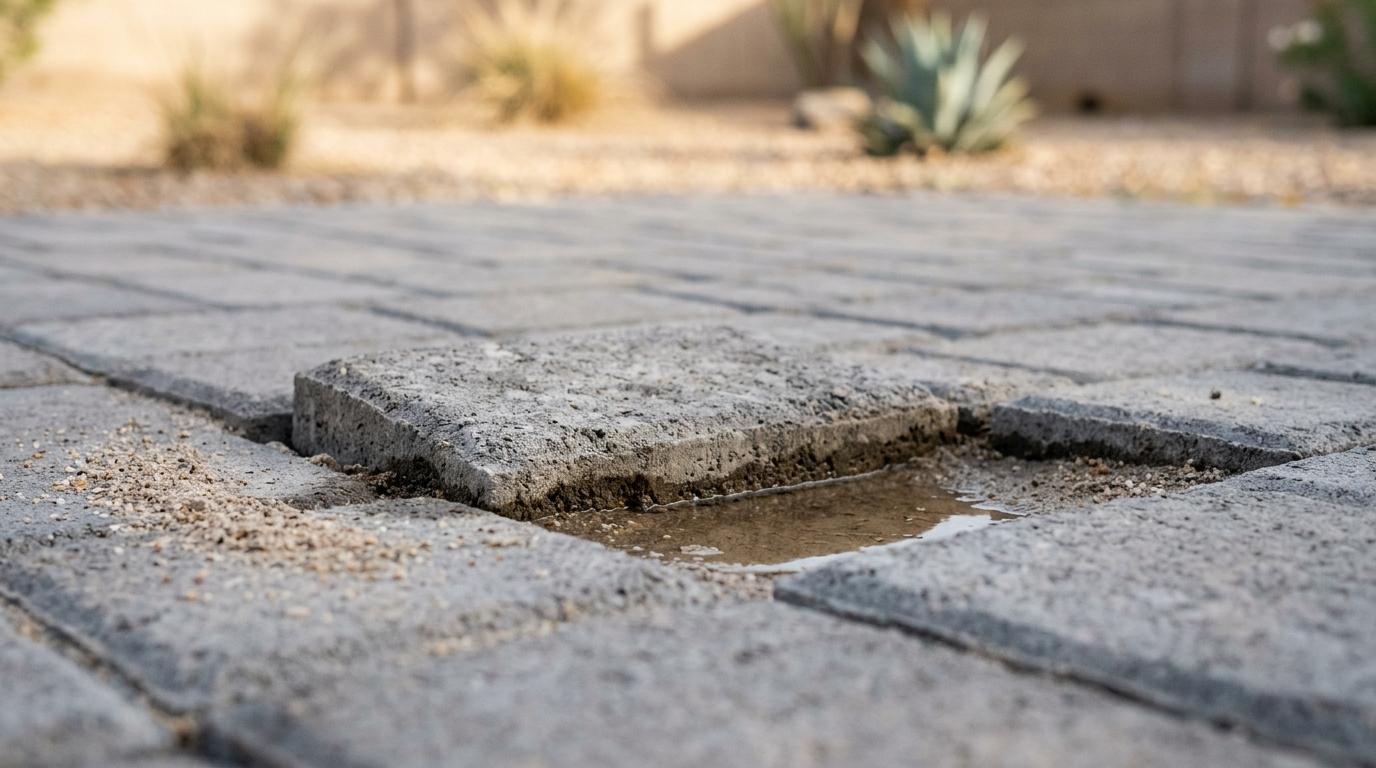
Uneven pavers can change the feel of an entire outdoor space. A driveway that once looked sharp starts to dip, a patio develops low spots that hold water, or a walkway becomes a tripping risk. In El Mirage, those problems often build slowly, then show up all at once after a monsoon storm, irrigation leak, or another long stretch of extreme heat.
Pro Natural Landscape LLC provides paver repair and re-leveling for homeowners, property managers, and commercial properties that need a durable fix rather than a temporary patch.
Why pavers shift in El Mirage
Desert landscapes put hardscapes under constant stress. El Mirage sees intense sun, wide temperature swings, dry periods, and sudden heavy rain. That combination can affect base materials, joint sand, edge restraints, and the soil below the surface.
Even a well-built paver surface can develop trouble over time if runoff is not directed properly or if the original installation did not include enough base preparation. In many cases, the visible problem is only the top layer of a larger issue below.
Common causes include:
- Soil movement
- Monsoon washout
- Irrigation overspray
- Poor drainage
- Inadequate base depth
- Weak edge restraints
- Heavy vehicle traffic
- Loss of joint sand
Signs your paver surface needs repair
Some damage is obvious. Some starts small and keeps spreading until the affected section becomes harder and more expensive to fix. Early repair usually protects more of the original installation and keeps the project focused on the problem areas.
You may need re-leveling or repair if you notice:
- Sunken areas: Low spots that collect water or create a soft, uneven walking surface
- Raised edges: Pavers that sit higher than surrounding pieces and create a trip hazard
- Wobbling units: Individual pavers that rock underfoot instead of staying firmly locked in place
- Joint loss: Sand washing out of the joints after wind, rain, or pressure washing
- Spreading pattern: Gaps widening at the perimeter or curves losing their shape
- Surface damage: Cracked, stained, or chipped pavers that affect appearance and function
A single loose paver can point to a much larger base problem.
What proper re-leveling involves
Quality paver repair is a methodical process. The affected section is typically lifted, the bedding and base are inspected, unstable material is removed, and the area is rebuilt to the right grade before the pavers are relaid and compacted.
That matters because resetting pavers over the same failed base usually leads to the same failure returning.
A repair approach built for desert conditions
In Arizona, re-leveling often calls for more than surface adjustment. The goal is to create a stable foundation that can handle heat, runoff, and daily use. Depending on the location and the type of paver area, repair work may include:
- Careful lift and reset: Existing pavers are removed with attention to pattern, fit, and reusability
- Base correction: Settled or washed-out aggregate is replaced and compacted in lifts
- Bedding layer adjustment: The screeded sand layer is brought back to a consistent grade
- Drainage improvement: Slopes, swales, or runoff paths are corrected to reduce future washout
- Edge restraint repair: Border sections are secured so the field of pavers stays locked together
- Joint stabilization: Fresh polymeric sand is installed to help resist erosion and weed growth
For patios and walkways, the finished surface should look clean and level. For driveways, it also needs to handle load.
Common problems and how they are addressed
Not every paver issue requires full replacement. Many surfaces can be restored by repairing the affected area and correcting the conditions that caused the movement.
| Problem | Likely Repair Strategy |
|---|---|
| Sunken patio section | Lift pavers, rebuild base, re-screed bedding sand, relay and compact |
| Pooling water near house | Regrade slope away from structure, reset pavers, improve drainage path |
| Loose or rocking pavers | Remove affected units, correct bedding level, refill joints with polymeric sand |
| Washed-out joints after storms | Clean surface, refill joints, compact, inspect for base erosion |
| Shifted driveway pavers | Re-level area, strengthen base for traffic load, secure edges |
| Cracked individual units | Replace damaged pavers and inspect surrounding field for movement |
| Spreading border | Rebuild or reinforce edge restraint and tighten paver pattern |
A strong repair preserves the look of the original design while correcting the weak point underneath.
Materials and methods that matter
In this climate, the details make a real difference. Angular crushed aggregate performs better than rounded material because it locks together during compaction. Proper bedding sand helps keep the surface even. Polymeric sand can help resist washout and limit weed intrusion in the joints.
Slope is another major factor. Paver surfaces should guide water away from structures and toward safe drainage areas. Without that, even a great-looking patio can start to fail after repeated storms or irrigation saturation.
For many projects, durable results depend on a few essentials:
- solid excavation
- stable compacted base
- consistent bedding layer
- correct pitch for drainage
- reliable edge restraint
- full joint sand installation
Repair or replacement?
Many property owners assume damaged pavers need to be torn out and rebuilt from scratch. Sometimes that is true, especially when the original installation has widespread base failure. In many other cases, targeted repair is the smarter move.
If the pavers themselves are still in good condition, lifting and relaying them can restore appearance and performance without changing the overall design. This is often ideal for patios, entry paths, courtyards, and portions of driveways where the problem is limited to certain sections.
A site visit helps determine whether the project calls for spot repair, partial reconstruction, or a broader reset of the paved area.
Residential and commercial applications
Paver repair is valuable anywhere safety, drainage, and appearance matter. The service is commonly used for:
- driveways
- front walkways
- backyard patios
- pool decks
- courtyards
- HOA common areas
- commercial entrances
For commercial sites and multi-property portfolios, prompt repair can also reduce liability tied to uneven walking surfaces.
Local experience that supports better results
Pro Natural Landscape LLC is a family-owned company serving El Mirage and surrounding Arizona communities with over a decade of experience in outdoor construction and landscape improvement. That local background matters when dealing with desert soils, harsh UV exposure, and monsoon runoff patterns.
Paver repair often connects with other site conditions, not just the paved surface itself. A sinking area may point to runoff concentration, irrigation issues, grading trouble, or failing borders. Because the company also handles drainage, gravel, grading, sealing, and related exterior improvements, repairs can be planned with the full outdoor space in mind.
Clear communication and on-time project delivery are a priority, and free estimates help property owners understand the scope before work begins.
What to expect from the service process
A good repair process should feel straightforward. The first step is an on-site evaluation of the affected area, including slope, drainage behavior, base failure signs, edge condition, and the amount of paver movement.
From there, the scope can be defined with practical recommendations that fit the site. That may involve re-leveling a small section, replacing broken units, rebuilding a border, restoring joint sand, or combining repair with sealing once the surface is stabilized.
In many cases, the process includes:
- Site assessment and estimate
- Removal of affected pavers
- Base and bedding correction
- Reinstallation and compaction
- Joint sand application and cleanup
If needed, financing options are available through Hearth, which can make larger repairs more manageable.
When timing matters
Waiting too long can turn a minor repair into a broader reconstruction. Low spots tend to collect more water. Loose pavers allow more movement. Lost joint sand weakens interlock. One damaged edge can let an entire field start to spread.
That is why early service often saves money and protects the original investment.
For property owners in El Mirage looking to restore a patio, walkway, or driveway, paver repair and re-leveling can bring back both function and curb appeal with a solution designed for Arizona conditions.