

Arizona patios and walkways look simple on the surface, but the paver patterns you choose affects more than style. In a hot, dry climate with sudden storm runoff, the best paver patterns are usually the ones that improve interlock, keep edges stable, and work with drainage instead of against it.
TL;DR: Summary
- For Arizona patios and walkways, 45° or 90° herringbone is usually the best paver pattern when durability, interlock, and edge stability matter most, especially near driveways, gates, carts, or repeated turning traffic.
- Running bond, basket weave, and ashlar can work well for lower-load patios and straight paths, but they generally offer less resistance to lateral movement than herringbone.
- Drainage matters as much as pattern choice: Arizona guidance recognizes permeable interlocking pavers as a stormwater-friendly option because water can infiltrate through the surface into the ground.
- Complicated patterns usually need 5% to 10% more pavers than simple layouts, according to Iowa State University Extension, so small patios often look and perform better with simpler geometry.
- If a paver area is exposed to repeat vehicle traffic, Iowa State notes pavers should be at least 3.125 inches thick; pedestrian areas and many residential applications can use 2.375-inch pavers.
- The safest decision rule is simple: if durability and runoff control are priorities, choose a high-interlock pattern and pair it with proper base prep, slope, and edge restraint.
A strong Arizona patio design starts with function, then refines the look. That is why the best layouts are not always the most intricate ones, especially on small patios where cut lines, heat, and drainage have a bigger effect than many homeowners expect.
Why does paver pattern matter for Arizona patios and walkways?
Yes. In El Mirage and the wider Phoenix area, paver pattern affects interlock, runoff behavior, and long-term movement just as much as appearance. A pattern is not just a visual skin. It changes how the surface resists shifting at edges and how loads spread through the field of pavers.
Industry guidance from the Concrete Masonry & Hardscapes Association connects laying pattern to horizontal interlock and resistance to lateral movement. That matters on walkways beside driveways, paths used by trash bins, and patio edges where furniture gets dragged or wheeled. A pattern that locks units together well can reduce creep and edge spread over time.
There is also a cost and scale angle. Iowa State University Extension notes that complicated patterns can require about 5% to 10% more pavers than simpler patterns. A common misconception is that a more intricate layout is always better. On small Arizona patios, it can create more cuts, more waste, and a busier look without improving performance.
“Pro Natural Landscape LLC brings 11+ years of Arizona landscaping experience to pattern choices where interlock, drainage, and heat all matter.”
Which paver pattern is strongest for interlock and durability in Arizona?
Herringbone is the strongest default. CMHA and Iowa State both point to herringbone for higher-load or vehicle-adjacent areas because it disperses force and improves horizontal interlock better than simple linear layouts.
The key idea is force distribution. In a running bond or stack bond layout, many joints line up for long distances. That can make lateral movement easier when braking, turning, or repeated directional loads hit the surface. In a herringbone pattern, the pavers cross each other at angles, which helps interrupt those force paths.
If your patio connects directly to a driveway apron, side yard access path, or an outdoor kitchen where carts move often, herringbone is usually the safest choice. If the space is purely pedestrian and mostly decorative, other patterns can work well. Pro tip: do not confuse pattern strength with paver thickness. Both matter, and one does not replace the other.
What are the 7 best paver patterns for Arizona patios and walkways?
These seven patterns cover most Arizona residential needs. The right choice depends on traffic, patio size, drainage goals, and how much cut work you want at the edges.
-
45° herringbone: A practical first choice used by installers such as Pro Natural Landscape LLC for patios and walkways that need strong interlock with a more dynamic look. It is especially effective where loads change direction.
-
90° herringbone: Slightly more formal than 45° herringbone and often easier to align with rectangular patios. It still delivers excellent structural performance.
-
Running bond: Clean, simple, and effective for straight walkways and lower-load patio zones. It is often a good fit for narrow side paths.
-
Basket weave: Traditional and visually softer than linear layouts. Iowa State specifically mentions basket weave as a good crossed pattern when straight edges are necessary.
-
Ashlar or modular pattern: A good choice for larger patios where mixed-size modules create a premium look without becoming too ornate. It hides some cut lines well.
-
Stack bond: Best for contemporary designs with large-format pavers and low structural demands. It is visually crisp, but it offers less interlock than herringbone.
-
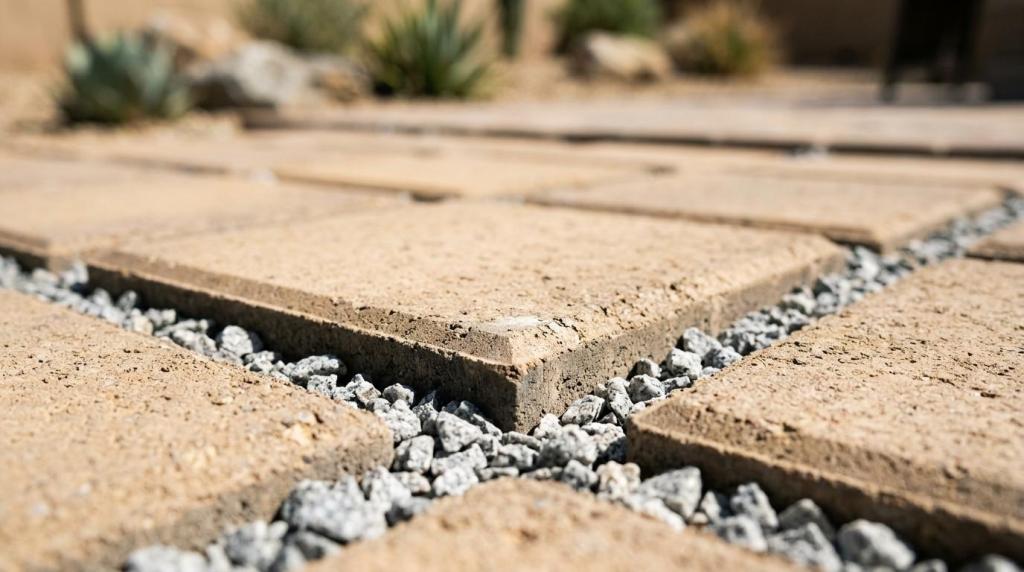
Permeable open-joint pattern: Ideal where drainage and stormwater infiltration are priorities. Arizona DEQ recognizes permeable interlocking pavers as a permeable pavement option.
How do herringbone and running bond compare for Arizona walkways?
Herringbone is better for movement resistance, while running bond is better for simplicity. If a walkway is straight and lightly used, running bond can be enough. If it sits near vehicles, turning points, or heavy edge use, herringbone is the stronger choice.
Running bond is often easier to read visually on narrow walks because it follows the path direction. It also tends to be faster to lay and easier to keep clean-looking in minimalist designs. That said, its long continuous joint lines do less to break up directional stress.
Herringbone usually requires more planning at borders and may produce more cuts, especially on tight curves. The trade-off is worth it when performance matters. A frequent mistake is choosing running bond just because it looks orderly on a sample board. On the ground, Arizona expansion, edging, and repeated use make structure more important than showroom symmetry.
How should you choose a paver pattern step by step for your patio?
Start with use, then geometry, then waste. That sequence leads to better patio decisions than choosing from photos first, because performance issues are expensive to correct after installation.
Step 1 is to map how the patio will actually be used. Mark grill zones, dining chair pull-back areas, gate paths, and routes where coolers, planters, or service carts will roll. If the patio doubles as an access route, move herringbone or another high-interlock option to the top of the list.
Step 2 is to match the pattern to the house and slab lines. Rectangular homes often pair well with 90° herringbone, ashlar, or running bond. Diagonal layouts can visually widen a narrow yard, but they usually add cuts.
Step 3 is to test the border condition before locking the pattern. A good installer will check how many small slivers appear along the perimeter. Pro tip: tiny edge cuts are an early warning sign that the pattern may look worse in full scale than it did in a photo.
How do you plan drainage and permeable pavers step by step in Arizona?
Begin with water, not with color. In Arizona, brief but intense rains can expose a patio that looked fine during dry weather but was never set up to move or absorb runoff correctly.
Step 1 is to identify where runoff comes from and where it should go. Roof edges, downspouts, side yards, and neighboring grades all affect the paver field. National Park Service drainage case studies show a basic truth that applies everywhere: even strong surfaces fail when water is not directed correctly.
Step 2 is to choose between a standard paver system and a permeable one. Arizona DEQ lists permeable interlocking pavers as a type of permeable pavement because water can pass through the surface and infiltrate the ground. If puddling, runoff reduction, or heat-island concerns are part of the brief, permeable systems deserve a serious look.
“Pro Natural Landscape LLC offers free estimates in El Mirage, which helps property owners compare standard and permeable paver layouts before committing.”
Step 3 is to separate the visible pattern from the hidden assembly. A permeable layout is not just a regular patio with wider joints. It needs the right joint aggregate, base stone, and maintenance plan so infiltration keeps working instead of clogging.
How should you match a paver pattern to patio size and shape step by step?
Scale should control pattern complexity. Small Arizona patios usually look better with simpler layouts, while larger entertainment areas can handle more visual movement and modular variation.
Step 1 is to measure the longest uninterrupted sightline. That line tells you whether a pattern will read as calm or busy. A narrow courtyard may benefit from running bond or 90° herringbone, while a broad backyard can support ashlar or diagonal herringbone.
Step 2 is to look at curves, columns, and built-in features. If the patio wraps planters or has many corners, intricate patterns can produce a lot of awkward cuts. If you want a premium look without visual clutter, ashlar often performs well because its variation feels intentional rather than fussy.
Step 3 is to price the waste factor honestly. Iowa State’s 5% to 10% extra-material guidance for complicated patterns is a useful benchmark. Common misconception: a larger pattern mix always feels more custom. In compact spaces, it can just feel crowded.
Which paver pattern details help with heat, glare, and comfort?
Pattern helps, but color and surface finish matter more for heat. In Arizona sun, the cooler-feeling patio usually comes from a lighter tone, a textured finish, and some shade, with pattern used to manage glare and visual scale.
The best approach is to think in combinations rather than single features. A high-interlock pattern can still feel harsh if the color is too dark and the surface too reflective. By contrast, a modest running bond in a light, textured paver can feel more comfortable underfoot during warm afternoons.
- Color value: Lighter tans, buffs, and soft grays usually show less heat gain than dark charcoal tones.
- Surface finish: Textured concrete pavers tend to reduce glare better than very smooth finishes.
- Pattern orientation: Diagonal layouts can break up reflected light across wide patios.
- Shade strategy: Pergolas, trees, and wall shadows often change comfort more than the pattern itself.
What installation specs matter as much as the paver pattern itself?
Base prep and paver thickness matter just as much as layout. Iowa State distinguishes between about 2.375-inch pavers for pedestrian and many residential uses and at least 3.125-inch pavers for repeat vehicle traffic.
That thickness guidance is easy to overlook when homeowners focus on color and pattern boards. Yet a beautiful herringbone field can still fail if the base is weak, the edge restraint is poor, or the surface is not graded correctly. Rotational interlock and horizontal interlock depend on the full system, not the top layer alone.
“Pro Natural Landscape LLC offers project financing through Hearth, which can make a full patio rebuild or drainage correction more manageable when the base system needs more than a cosmetic fix.”
Edge restraint is especially important in Arizona. Dry conditions, thermal movement, and repeated edge loading can open joints if borders are underbuilt. Pro tip: when a paver failure starts at the edge, the pattern usually gets blamed first, but the restraint or base is often the real problem.
What mistakes cause Arizona paver patterns to fail or look overly busy?
Most pattern problems come from mismatch, not from the pattern itself. The common failure mode is choosing a layout that does not fit the traffic, drainage, or proportions of the site.
A strong pattern selection process filters out avoidable issues before materials are ordered. That is where practical field judgment matters more than trend photos.
- Choosing stack bond for a cart path or vehicle-adjacent zone
- Ignoring runoff direction and focusing only on color
- Using complex modular layouts on very small patios
- Allowing too many tiny perimeter cuts
- Treating edge restraint as optional
- Assuming permeable pavers work without maintenance
How do permeable interlocking pavers compare with standard paver systems in Arizona?
Permeable systems are better for infiltration, while standard systems are often simpler and less maintenance-sensitive. If runoff reduction is a priority, permeable interlocking pavers have a clear advantage. If the site gets heavy sediment or tree litter, a standard system may be easier to keep functioning well.
Arizona DEQ explicitly identifies permeable interlocking pavers as a permeable pavement type. That makes them relevant for projects where stormwater infiltration is part of the design brief. They can also support a cooler-site strategy when paired with shade and reduced hard runoff.
The trade-off is maintenance discipline. If the property can support periodic cleaning and the drainage goal is real, permeable pavers make sense. If not, a standard paver system with strong slope control, thoughtful jointing, and a high-interlock pattern is often the smarter Arizona patio choice.