

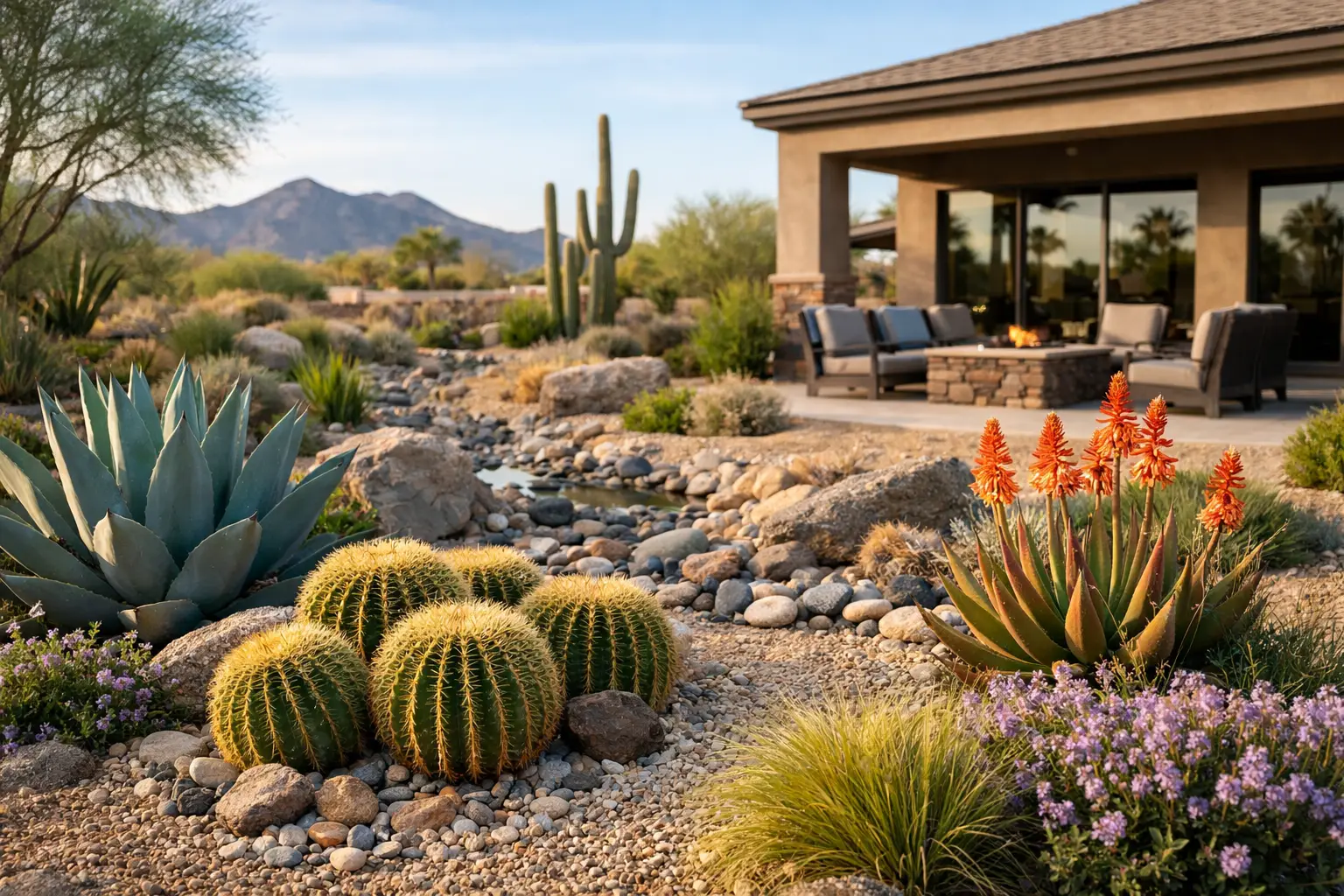
A desert yard does not have to mean a bare yard. The best xeriscape trends in Arizona are moving away from empty rock fields and toward outdoor spaces that look finished, provide usable shade, and need far less water than a traditional lawn. For homeowners, property managers, and commercial owners, the goal is practical: reduce upkeep, control water use, and create curb appeal that holds up through long summers.
A successful xeriscape is not simply a yard covered in gravel. It is a planned landscape that matches plants, irrigation, hardscape, and drainage to the property. When those pieces work together, the result is a cleaner, more durable outdoor space that can handle Arizona heat without demanding constant attention.
Xeriscape Trends That Make Arizona Yards More Usable
Layered desert planting replaces the one-plant look
Older low-water landscapes often relied on a few scattered shrubs surrounded by rock. Current designs are more layered. They combine small shade trees, flowering desert shrubs, ornamental grasses, agave, cacti, and ground-level accent plants to create depth without creating a high-water yard.
This approach gives a property more color and texture throughout the year. Desert willow, palo verde, Texas sage, lantana, brittlebush, chuparosa, and certain agaves can each play a role, depending on sun exposure and the amount of space available. The right selection matters more than planting as many varieties as possible. A crowded landscape can quickly become difficult to trim, clean, and irrigate.
For commercial properties, repeated plant groupings often look more organized and are easier for maintenance crews to manage. At a home, planting in clusters can soften a block wall, frame a patio, or add privacy along a side yard.
Shade is becoming a central design feature
Arizona property owners are putting more attention on shade because it changes how often an outdoor space can actually be used. Shade trees, pergolas, patio covers, and strategically placed walls can reduce direct sun exposure around seating areas, walkways, and windows.
The key is to plan for mature growth rather than the size of a newly installed tree. A tree planted too close to a wall, pool deck, paver area, or underground utility can become a future repair problem. Trees also need enough room for healthy roots and access for trimming.
Built shade and living shade work well together. A pergola can provide immediate relief near a patio, while a properly placed tree offers long-term cooling and visual balance. This combination is especially useful for backyards where families want a usable grilling, dining, or gathering space instead of a patio that sits empty for much of the day.
Decorative gravel is more intentional
Gravel remains one of the most dependable low-maintenance ground covers in Arizona, but the trend is toward using it with purpose. Homeowners are choosing colors that complement their homes, pavers, walls, and artificial grass instead of applying one material across every part of the yard.
Gravel can define planting beds, create pathways, cover side yards, and improve the finished appearance around utility areas. It also helps limit exposed soil and muddy spots after rain. However, gravel alone is not maintenance-free. Leaves, windblown debris, and weeds can still build up, especially if the base preparation or weed barrier is poor.
Proper grading and edging make a major difference. Without them, gravel migrates into walkways, washes into low spots, or blends into adjacent landscape areas. Clean borders around pavers, turf, and planting zones give xeriscape yards the sharp, cared-for appearance that many property owners want.
Artificial grass is used as an accent, not a full replacement
Artificial grass continues to be a strong option for Arizona yards, especially where owners want green space without the water, mowing, and reseeding associated with natural turf. One of the more practical xeriscape trends is using turf in targeted areas rather than covering the entire property.
A compact artificial grass area can create a play zone for children, a cleaner space for pets, or a visual break between gravel and hardscape. It works well beside a patio, around a pool area, or in a small front-yard feature. Limiting turf to the areas where it provides real value keeps the design balanced and helps control installation costs.
Artificial grass does get hot in direct sun, and it requires occasional rinsing, brushing, and debris cleanup. It is not the best solution for every location. In heavily shaded areas, near messy trees, or in spaces with poor drainage, the installation plan needs extra attention. A quality base and proper drainage are essential for a surface that stays level and performs well.
Smart irrigation supports water-conscious landscapes
Low-water plants still need water, especially during establishment. The difference is that xeriscape irrigation should deliver water efficiently to plant roots instead of spraying sidewalks, gravel, and block walls.
Drip irrigation remains the preferred system for most desert planting beds. Smart controllers, rain sensors, pressure regulation, and properly placed emitters help reduce waste while giving plants a consistent schedule. Irrigation zones should be separated by plant needs. A young tree, a group of flowering shrubs, and a mature cactus should not necessarily receive the same watering cycle.
This is where many yards fall short. A property may have drought-tolerant plants but still waste water through broken lines, clogged emitters, poor timer settings, or overspray from an old sprinkler system. Updating irrigation during a landscape renovation is often more cost-effective than tearing up finished areas later to make repairs.
Pavers and decomposed granite create durable outdoor zones
Water-wise landscaping increasingly includes hardscape that gives people a reason to spend time outdoors. Pavers, travertine, brick, and decomposed granite can turn an underused yard into a defined patio, path, fire-pit area, or seating space.
Pavers are especially popular because they offer a finished look and can be designed around curves, planters, turf insets, and outdoor kitchens. They are also repairable in a way that poured concrete is not. If an area needs access for plumbing or irrigation work, individual pavers can often be removed and reset.
Decomposed granite provides a more natural, desert-style surface for pathways and casual gathering areas. It can be less expensive than pavers, but it may need periodic replenishment and can move under heavy foot traffic if it is not installed on a well-prepared base. The right choice depends on how the area will be used, not just on appearance.
Designing Xeriscape Trends for Front Yards and Backyards
Front yards are often focused on curb appeal, clean access, and low-maintenance coverage. A strong front-yard plan may include gravel beds, a few statement plants, a shade tree, defined paver walkways, and lighting that makes the entry visible at night. For rental homes and commercial properties, this type of layout can be easier to maintain than a traditional lawn-heavy design.
Backyards usually need more function. A xeriscape backyard can include a paver patio, artificial grass for activity space, raised planters, a gravel path, desert plants for privacy, and landscape lighting around key features. The best layouts leave enough open space for movement and do not place high-maintenance planting beds where people need to walk or entertain.
Drainage should be part of the design from the start. Arizona rain can arrive fast, and water needs a clear route away from foundations, patios, and low areas. Land grading, swales, and carefully placed gravel can help manage runoff without making the yard look like a drainage project.
What to Avoid When Updating a Water-Wise Yard
The biggest mistake is treating xeriscaping as a quick cover-up for a worn-out yard. Adding rock over compacted soil, old weeds, failing irrigation, or poor grading will not solve the underlying problem. It usually creates more work later.
Avoid planting large trees or aggressive-root plants too close to hardscape and walls. Do not mix plants with very different watering needs on the same irrigation zone. Be cautious with too many decorative materials, too. Several gravel colors, multiple paver styles, artificial turf, boulders, and dense planting can make a small yard feel busy instead of polished.
A dependable plan uses a limited material palette and gives every feature a job. Trees provide shade. Gravel provides coverage. Pavers create access and living space. Irrigation supports plant health. Lighting improves safety and nighttime appearance.
For a complete property update, Pro Natural Landscape can coordinate the work that often gets split between several contractors, including design, gravel installation, artificial grass, irrigation, pavers, tree work, grading, and ongoing maintenance. That makes it easier to build a yard where the finished pieces work together.
The right xeriscape does not try to fight the Arizona climate. It uses that climate as the starting point, then builds a cleaner, cooler, lower-maintenance space around the way you actually live or manage the property.