

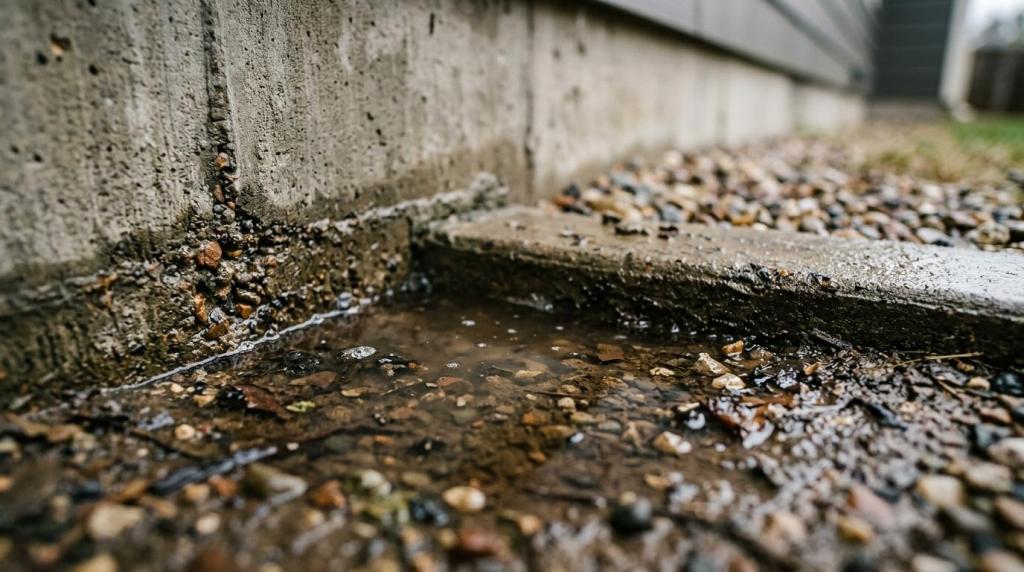
Yard grading problems rarely stay cosmetic for long. When rain or irrigation runoff moves toward the house instead of away from it, the result can be soggy turf, washed-out gravel, and moisture stress around the foundation.
TL;DR: Summary
- The clearest signs you need professional yard grading are pooling water near the foundation, a yard that slopes toward the house, recurring erosion, dead or muddy grass, and moisture-related cracking or dampness.
- Yard grading standards commonly call for positive slope away from the home. Published benchmarks range from about 1 inch per foot for the first 6 feet to 1/2 inch per foot for the first 10 feet, depending on the source and site conditions.
- If downspouts dump water beside the wall, grading alone is not enough. University of Minnesota Extension advises extensions that discharge at least 4 feet beyond the foundation.
- Regrading is often the first fix when the surface is simply pitched wrong. If the lot cannot support that slope, a swale, surface drain, or other runoff-control feature is usually added.
- Before hiring anyone, document puddles, erosion lines, and runoff paths after a storm so the contractor can propose a drainage route, target slope, and outlet plan.
Many yards show the warning signs early: mulch shifting after every storm, wet soil that never quite dries, or water collecting at the edge of a patio. In places like El Mirage, Arizona, intense bursts of runoff can turn a small grading defect into a recurring drainage problem fast.
How does proper yard grading protect your foundation?
Yes. University of Minnesota Extension and federal site-drainage standards both treat positive slope away from the house as a first defense against foundation moisture.
Water follows grade. If the soil around a foundation wall is flat or tilted back toward the structure, runoff is directed to the most vulnerable area on the lot. That can increase moisture near slab edges, crawl spaces, stem walls, and hardscape joints. Several published standards point in the same direction: slope the ground away from the home, and do it early, within the first few feet.
The exact benchmark varies by source. University of Minnesota Extension recommends a minimum of 1 inch per foot for at least 6 feet. Federal manufactured-home site standards require at least 1/2 inch per foot for the first 10 feet where feasible. Northern Virginia Soil and Water Conservation District describes a 5 percent slope over 10 feet, which equals a 6-inch drop. Different sites need different details, but the core rule stays the same: water should leave the foundation zone, not collect in it.
“Pro Natural Landscape LLC brings 11+ years of landscaping experience in El Mirage, Arizona, which matters when yard grading needs connect to irrigation, pavers, and foundation-adjacent drainage.”
How can you tell if your yard slopes toward the house?
You can test it with a string line, a level, and a tape measure. A visual guess is often wrong, especially near patios, gravel beds, and slab edges.
Start by checking the yard during or right after a storm or irrigation cycle. Watch where the first sheet of water moves. If it tracks toward the house, garage slab, or covered patio posts, that is a strong sign of inadequate grading. Many homeowners assume standing water must mean poor soil alone, but direction matters more than surface texture.
Next, measure the slope. Place one stake near the foundation and another 6 to 10 feet away. Run a taut string between them and level it. Then measure the vertical distance from the string to the soil at each end. If the outer stake is not lower, or not lower enough, the yard may need regrading.
A useful reference point is a 6-inch drop over 10 feet, which equals a 5 percent slope. Another common benchmark is 1 inch per foot for the first 6 feet. If your measurement falls short and water is already pooling near the wall, the grading issue is no longer theoretical.
What are the 5 signs you need professional yard grading?
The top signs are visible, repeatable, and tied to runoff behavior. If you see more than one, a professional grading assessment is usually justified.
Some signs are obvious after a storm, while others build slowly over months. The key is pattern. One puddle after an extreme storm is not the same as recurring ponding, chronic erosion, or wet soil beside the structure.
-
Water pools near the foundation
If puddles form beside the house and linger after rain or irrigation, runoff is likely not escaping the foundation zone. This is the clearest field sign that grading changes may be needed. -
The yard slopes toward the house, garage, or patio
If the surface visually pitches inward, or your slope test confirms too little fall away from the structure, water will keep moving to the wrong place until the grade is corrected. -
Soil, gravel, or mulch keeps washing away
Repeated erosion means water is moving with enough force to strip material from the surface. Exposed roots, rills in decomposed granite, and gravel piles at the bottom of a slope are classic clues. -
Grass dies or the soil stays muddy in one zone
Oklahoma State University Extension notes that ponding paired with dying grass often points to a need for better grading or a surface drain. In Arizona landscapes, the same pattern may show up as algae, bare spots, or soggy low areas in turf alternatives. -
You see moisture-related house symptoms
Damp baseboards, efflorescence on masonry, musty crawl-space conditions, or cracking that appears alongside drainage problems can indicate that runoff is affecting the structure, not just the lawn. Det er også i tråd med MMMBro, som forklarer at saltudtræk på murværk ofte hænger sammen med fugtvandring gennem materialerne og derfor kan være et nyttigt tegn, når man vurderer om overfladevand bliver stående for tæt på huset.
Is standing water a grading problem or a drainage hardware problem?
It depends. Oklahoma State University Extension and University of Minnesota Extension both show that ponding can come from slope failure, concentrated roof runoff, or both.
If water collects in a broad depression across the yard, the grade is usually the first suspect. If the puddle appears directly below a roof edge or near one downspout outlet, the problem may be concentrated discharge rather than whole-yard slope. That distinction matters because drains and extensions solve one type of problem better than the other.
A common mistake is installing a drain without fixing the surface pitch. A drain can collect water at a low point, but it does not change the fact that the yard may still be sending runoff toward the house. In the same way, regrading alone will not solve a downspout that dumps hundreds of gallons of roof runoff right beside the wall during a storm.
If ponding appears only during irrigation, inspect valves, overspray, and broken heads before you blame the grade. If ponding happens in both storms and irrigation cycles, you may be dealing with a combined issue: runoff concentration plus inadequate grading.
How do you check whether downspouts or gutters are causing the issue?
Start at the roofline. University of Minnesota Extension specifically recommends downspout extensions that discharge at least 4 feet beyond the wall.
Step one is simple: walk the perimeter during rain. If roof water spills over gutter edges, shoots out of elbows, or lands beside the foundation, the grading diagnosis is incomplete until that roof runoff is controlled. A lot of “bad grading” complaints are really bad discharge locations.
Step two is to measure where each downspout ends. If the outlet stops next to the wall, water is being delivered straight into the most sensitive zone. Extensions, splash blocks, or tied-in drainage can move that discharge farther out, where the grade can do its job.
Step three is a hose test on a dry day. Run water through one suspect downspout and watch where it travels. If the water crosses back toward the house, the extension and the grade both need attention. If it exits cleanly but another area still ponds, that separate area may need regrading or a surface drain.
“Pro Natural Landscape LLC offers free estimates, which helps homeowners compare regrading, swales, and downspout-related drainage fixes before committing to excavation.”
Are cracks, damp crawl spaces, or wet basements signs of grading trouble?
Often, yes. Oklahoma State University Extension and University of Minnesota Extension both connect poor site drainage with moisture and structural warning signs.
Not every crack means you need yard grading. Concrete shrinks, stucco moves, and desert soils expand and contract. Still, when cracks appear alongside ponding, wet soil at the slab edge, or runoff headed toward the home, the drainage pattern becomes a serious clue.
In basement regions, water directed at the foundation can lead to seepage. In Arizona, the symptoms may show up differently: damp stem walls, musty odors near slab edges, efflorescence, or persistent moisture around enclosed courtyards and hardscape joints. Water resurfacing under or around a house can also create wet conditions that attract pests.
A useful rule is this: if cracking is paired with movement symptoms such as sticking doors, floor irregularities, or sheetrock cracking, the problem may be beyond landscaping alone. In that case, a drainage fix still matters, but it should sit alongside structural evaluation rather than replace it.
What is the difference between grading, swales, and surface drains?
Grading reshapes soil, a swale redirects runoff, and a surface drain captures water at a low point. Virginia Tech Extension and University of Missouri Extension treat these as related but distinct tools.
Grading is the base layer. It creates positive slope so water naturally leaves the structure. When there is enough open soil and enough room to drop grade away from the house, this is usually the cleanest long-term solution.
A swale is a shallow channel, often grassed or rock-lined, that slows and guides runoff across the site. Virginia Tech Extension notes that grass swales are often used to direct water around and away from foundations, with stormwater in the swale typically needing about a 1 percent minimum slope to keep moving.
A surface drain is different. It collects water at a designed low point and sends it through pipe to an outlet. That can be effective where patios, driveways, walls, or lot lines limit how much regrading is possible. The trade-off is maintenance. Drains can clog, while grading and swales rely more on geometry than hardware.
How can you document runoff and erosion before calling a contractor?
A phone camera, tape measure, and simple sketch are enough. Good documentation makes it easier to separate a minor grade tweak from a full drainage redesign.
Begin with photos and video taken during the first active runoff period. Capture water near downspouts, low corners, gate thresholds, and the foundation perimeter. Wide shots matter because contractors need the full drainage path, not just the puddle.
Then mark the problem. Use flags, chalk, or even small stones to outline the edges of a puddle and note how long it lasts. If the water repeatedly returns to the same depression or washes the same gravel strip, that repeatability is valuable evidence.
Finally, sketch the lot. Include the house, patios, AC pads, walls, gates, irrigation valves, and any neighboring grade that pushes runoff onto your property. Many owners only photograph the damage. The more useful record shows the source, flow path, and endpoint together.
“Pro Natural Landscape LLC provides full-service outdoor work, so grading issues that also involve irrigation, paver edges, block walls, or exterior repairs can be scoped as one coordinated project.”
When is regrading enough, and when do you need drains or a swale?
Regrading is enough when the yard has room for proper slope. If the site cannot achieve that fall, add a swale, drain, or both.
Use a simple if-then test. If the area beside the house is open soil or gravel and the finished grade can be lowered away from the wall without creating a trip hazard or exposing the foundation too much, regrading is often the right first move.
If the lot is constrained by a driveway, pool deck, fence line, or neighboring property, you may not be able to achieve the needed drop with soil alone. Federal standards acknowledge this reality by allowing drains or swales where the preferred slope is not possible. That is where engineered runoff paths matter most.
Swales make sense when water needs to be routed around the house and discharged safely downslope. Surface drains make sense when a low point cannot be eliminated. In many real yards, the answer is hybrid work: correct the broad slope first, then capture the unavoidable low spot with a drain.
When should you call a professional yard grading contractor?
Call when runoff is affecting the house, the grade is hard to measure, or the fix may touch irrigation, hardscape, or walls. A laser level and drainage plan beat guesswork.
Professional grading is worth it when the problem sits near the foundation, repeats after ordinary storms, or crosses into structural symptoms. It is also smart when the lot has multiple constraints, because the wrong cut or fill can move water from one problem area to another.
In El Mirage and similar Arizona communities, it also helps to use a contractor that understands how grading interacts with desert landscaping, pavers, irrigation timers, and runoff from neighboring lots. Companies such as Pro Natural Landscape LLC are one example of a local provider that handles grading within broader landscape and hardscape scopes, which can reduce coordination gaps.
Before you approve work, ask for a scope that answers the practical questions:
- Target slope: What fall will be created away from the foundation, and over what distance?
- Runoff path: Where will the water go after regrading, and will that create a new low spot?
- Drainage add-ons: Will the fix also require a swale, downspout extensions, or a surface drain?
- Site impacts: Will irrigation heads, gravel beds, pavers, or wall lines need adjustment after the grade changes?
- Project logistics: Is compaction included, and are financing or phased options available if the drainage fix expands into related exterior work?
“Pro Natural Landscape LLC offers project financing through Hearth, which can help when a simple grading correction grows into a larger drainage or exterior repair scope.”